On this page · 9 sections
In short
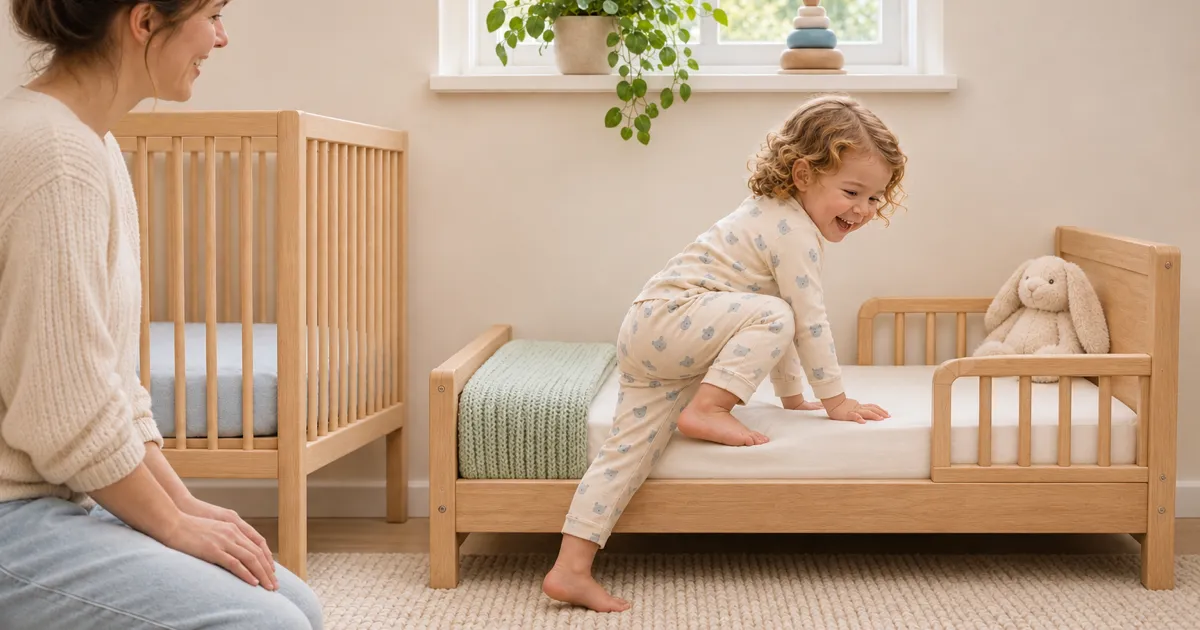
Most children move from the crib to a bed between 18 months and 3 years. If your child sleeps well and the crib is still safe, there is no rush: in a study of almost 2,000 children aged 18 to 36 months, those still in a crib went to bed earlier, woke less often and protested less at bedtime. The strongest reason to switch early is that they try to climb out over the rail. In children under 2, two in three injuries related to cribs, playpens and bassinets are falls.
At what age do you move a baby from the crib to a bed?
There is no fixed date, but there is a clear range: most children switch between 18 months and 3 years, and switching at 3 and a half is still normal.
A study published in Sleep Medicine in 2019 (Williamson, Mindell and colleagues) of 1,983 children from five Western countries found that 63% of children aged 18 to 24 months, 34% of those aged 24 to 30 months and 13% of those aged 30 to 36 months were still in a crib.
In general, a child under 2 is not emotionally or developmentally ready for a regular bed. At the other end there is a physical limit: at around 3 feet (90 centimeters) tall, they should be sleeping in a bed.
| Age | What is usual | What to keep in mind |
|---|---|---|
| Under 18 months | It is normal for them to still be in a crib. | If they try to climb, lower the mattress and remove anything they use as a step. |
| 18-24 months | About 6 in 10 are still in a crib. | Switch only if they climb or there is a clear reason: staying in bed because of a rule is still very hard for them. |
| 2-3 years | Between 24 and 30 months, 1 in 3 is still in a crib; between 30 and 36 months, only 1 in 8. | If they sleep well in the crib, waiting until age 3 can benefit their sleep. |
| 3 years and older | At around 3 feet (90 centimeters) tall, they should already be sleeping in a bed. | Methods with agreed rules, like the bedtime pass, already work. |
How do you know if your child is ready to leave the crib?
The sign that really counts is about safety: that they try to climb out over the rail. Falls are the main risk of this furniture: an analysis of 19 years of US emergency department visits (Yeh and colleagues, Pediatrics, 2011) found that they caused 66% of injuries related to cribs, playpens and bassinets in children under 2, and that the head and neck were the most injured area (40%).
Do not rely on “they are still too small to get out” either: many children aged 12 to 36 months who are under 3 feet (90 centimeters) tall manage to climb over rails of the minimum height required by US regulations, and the higher the rail, the fewer manage it. Count what they try to do, not how tall they are.
Before switching beds, try two things. Lower the mattress to its lowest position (and keep lowering it as they grow) and take large stuffed toys and cushions out of the crib, which they use to get a leg over. A sleep sack is not the solution: it may raise the risk of a fall if they try to walk in it.
If they keep climbing with the mattress at its lowest, or seem about to manage it, it is time to stop using the crib. Until the bed arrives, put the crib mattress on the floor and take the crib out of the room so they cannot keep climbing it.
Another, less urgent reason is that they need to go to the bathroom at night: a bed they can get out of by themselves gives them that independence.
 Raffy · free on Android
See how their nights change
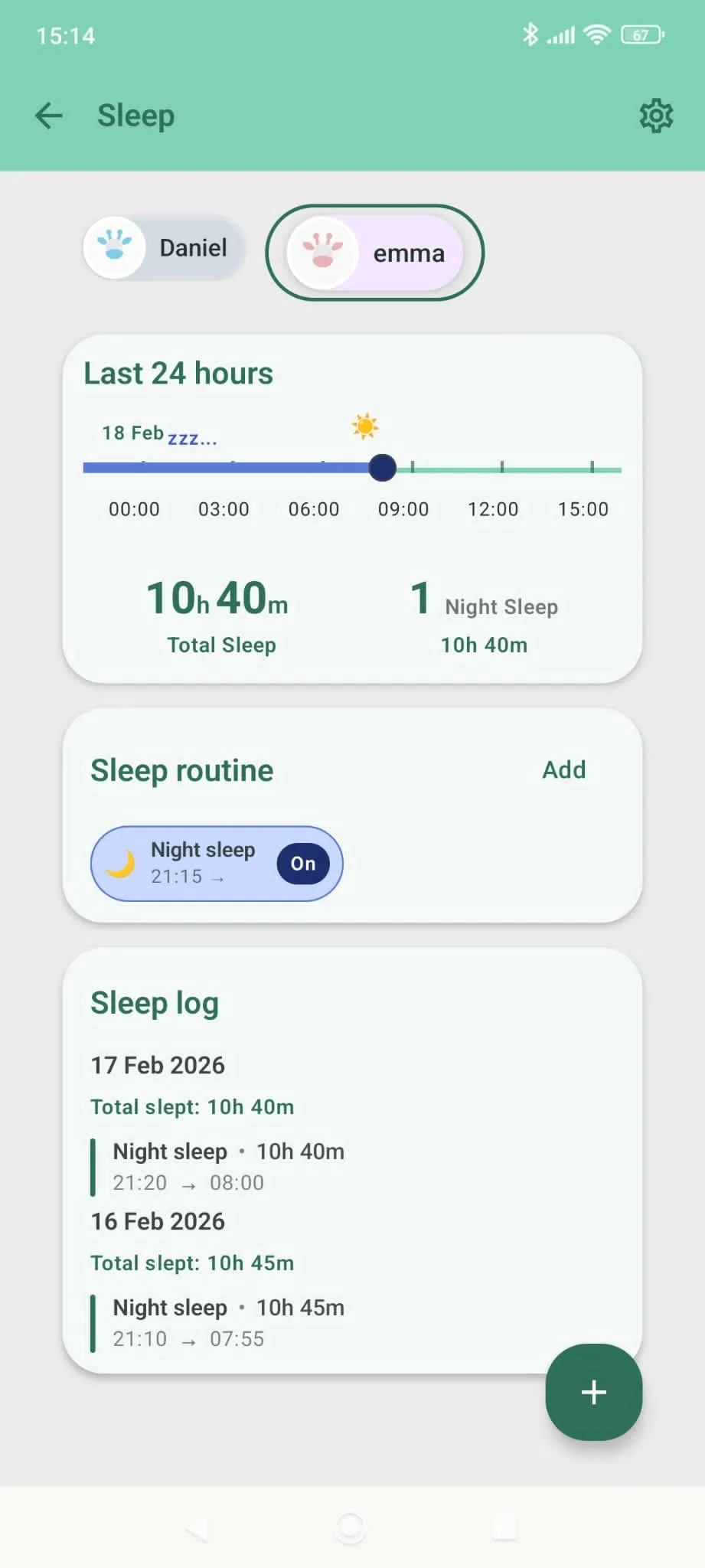
Log sleep in Raffy, with reminders and a diary, and see how nights evolve during the transition.
Is it better to wait if they sleep well in the crib?
Yes. In that same study, sleeping in a crib was associated, at every age and in every country, with going to bed earlier, falling asleep sooner, waking less, sleeping more at night and resisting bedtime less. The authors conclude that delaying the switch until age 3 may benefit sleep.
Caveat: the data come from parents and show an association, not a cause. Perhaps the children who slept worse are the ones who switch earlier. But there is no evidence in favor of switching early in a child who sleeps well and does not climb. In a crib, the rail keeps them from getting up. In a bed, that depends on their self-control.
If the crib is needed for a sibling, make the switch well before the birth or a few months after, but not right when the baby arrives. If the newborn is going to sleep in a bassinet or a small crib for the first months, you have more leeway than it seems.
Also avoid timing it with a house move, starting daycare or daytime potty training: if sleep gets worse, you will know why.
Which bed to choose: low bed, mattress on the floor or convertible crib?
| Type of bed | Pros | Cons | What to check |
|---|---|---|---|
| Low bed with a guard rail | Low height and a side boundary that feels familiar. | It is outgrown sooner than a regular bed, and a partial rail does not stop them from getting up. | Reuse the crib mattress only if the bed’s manufacturer says it is compatible. |
| Mattress on the floor (Montessori style) | If they fall, there is barely any height. They can get down on their own to go to the bathroom, and it is an instant fix if they climb. | Total freedom from the first night: the whole room has to be prepared. | Keep it away from walls and furniture so there are no gaps where they could get trapped. |
| Convertible crib | Same furniture, same mattress and same spot; no need to buy another bed. | You must have chosen it that way from the start. Once the side panel comes off, nothing stops them getting up, as with any bed. | Use only the manufacturer’s kit; do not improvise rails or barriers. |
If you use a regular bed with a portable rail, the rail should sit flush against the mattress. If there is a gap between the two, your child can get trapped in it: in that case, stop using the rail. The space between the bars should be no more than 95 millimeters (about 3.7 inches). The Spanish Association of Pediatrics (AEP) points out that suffocation can occur when a small child gets trapped between the mattress and the wall.
Bunk beds are for later: they should not sleep in the top bunk until age 9.
How do you move a child from the crib to a bed step by step?
If it is not urgent, prepare it a few days ahead.
- Pick a calm week: no imminent birth, house move or new daycare.
- Prepare the room. Use the safety checklist below.
- Involve them. Let them pick the sheets or bring their usual soft toy to bed, a safe object that keeps them company.
- Put the bed where the crib was. When they wake up, they will see the same things as always.
- Explain the rule before putting them to bed. One simple rule is enough: at bedtime, we stay in bed until morning, except to go to the bathroom.
- Praise them in the morning if they spent the night in their bed.
Keep a pre-sleep routine that ends in their bed, set times and a quiet bedroom at 16-20 °C (61-68 °F).
Some children are restless the first nights, but not every waking is the switch’s fault: between 20 and 40% of children under 3 wake at night, and 15% at age 3.
To tell a rough patch from a problem, log sleep in Raffy during the weeks of the switch and note in the diary each night: you will see whether it improves or stalls.
To adjust schedules and naps, see the baby sleep routine by age, the wake window planner or the nap transition helper.
What to do the first nights and if they get out of bed?
The simplest method is the calm return: take them back to bed calmly and quietly, remind them they need to stay there, briefly tell them they are doing great when they lie down, and leave the room. You can promise to check on them, and keep that promise. You may have to repeat it quite a few times the first nights; make every return equally boring.
Confrontations and punishments increase their anxiety and can drag the problem out. It is also best that the escape does not end in your bed: if getting out works, they will repeat it.
From age 3, the bedtime pass works well: a card the child trades for a single trip out or visit after being tucked in (water, a hug, the bathroom). Once it is used, no more calls are answered that night. In a small randomized trial with 19 children aged 3 to 6 (Moore and colleagues, 2007), those who used it got out of bed, called out and cried far less, calmed down sooner and kept the improvement at 3 months. In another small study of 3-year-olds, the pass also ended resistance to going to bed, without the surge in protests that usually comes when parents simply ignore them.
These studies were done with children aged 3 or older, and that makes sense: following a rule without a rail to hold it demands self-control that matures gradually. At 18-24 months, do not expect them to “understand” the rule: expect to bring them back to bed many times.
How do you make the bedroom safe?
As soon as they can get out of bed, a child reaches dangers that used to be out of reach, and between ages 1 and 4 the most common falls involve stairs, windows or balconies, and furniture.
Pediatric safety
- Furniture anchored to the wall. Dressers, bookcases and TVs, and drawer locks so they cannot be used as steps.
- Windows. No furniture in front they could climb on, and a limiter that allows only a partial opening, no more than about 10 centimeters (4 inches).
- Curtain and blind cords. Best with no cord; if they have one, shorten it as much as possible so it does not hang down.
- Outlets. Covers the child cannot easily remove and large enough that they cannot choke on them.
- Stairs and door. A barrier at the top screwed into the wall; at the bottom it can be pressure-mounted. The AEP recommends barriers only up to 24 months, because after that the child’s weight and strength make them a poor choice. And they never replace supervision.
- Clear floor. Remove furniture and large toys, such as a rocking horse, they could hit if they fall.
- Gaps around the mattress. None between mattress and wall or between mattress and rail.
- Bedding by age. No pillow or bedding before age 1; a pillow only after 2 years and once they no longer sleep in a crib. When they sleep in an open bed, choose clothing they can stand and walk in without tripping, not a sleep sack.
- No food or drink in bed. Do not leave them alone with food or drink while they are lying down.
This guide is educational and does not replace your pediatrician: if sleep problems persist after the switch, consult them.
Frequently asked questions
At what age should a child move from the crib to a bed?
There is no exact age: most children switch between 18 months and 3 years. If they sleep well and do not climb, you can wait.
Is moving to a bed at 18 months too early?
It is within the usual range, but at that age about 6 in 10 children are still in a crib and find it very hard to stay in bed because of a rule. Do it only if they climb or there is a clear reason.
What do I do if my child climbs out of the crib?
Lower the mattress to its lowest position and remove large stuffed toys or cushions they use as a step. If they still get out, stop using the crib: put the mattress on the floor that same night and make the room safe.
Is a bed with a guard rail or a mattress on the floor better?
Both are low, which is what matters. A mattress on the floor almost eliminates the fall, but it requires the whole room to be safe. In both cases, no gaps between mattress, wall or rail.
How long does it take a child to get used to sleeping in a bed?
There is no reliable number. It is common for them to be restless the first nights and for you to have to take them back to bed several times.
Should I move them to a bed before their sibling is born?
If you need the crib for the baby, make the switch well before the birth or wait until a few months after, but not right when the baby arrives.
When can they use a pillow?
Never before age 1. It is best to wait until they are over 2 and no longer sleep in a crib.
Is moving to a bed the same as moving to their own room?
No. They can try out the bed in the same room and change rooms at another time.
Sources
- American Academy of Pediatrics · HealthyChildren.orgBig Kid Beds: When to Switch From a Crib
- American Academy of Pediatrics · HealthyChildren.orgChoosing a Crib
- NHS · Cambridgeshire and Peterborough Children’s HealthKeeping your sleeping baby safe
- Spanish Association of Pediatrics · En FamiliaHábitos saludables de sueño: higiene de sueño (in Spanish)
- Spanish Association of Pediatrics · En Familia (PrevInfad)Caídas, muy frecuentes y a veces peligrosas (in Spanish)
- Better Health Channel · Victoria State Government (Australia)Baby care: moving from cot to bed
- Red Nose AustraliaWhen to move from cot to bed
- Red Nose AustraliaMoving your child from a cot to a bed
- U.S. Consumer Product Safety Commission (CPSC)Anchor It! Preventing furniture and TV tip-overs
- U.S. Consumer Product Safety Commission (CPSC)Childproofing Your Home
- Sleep Medicine, 2019 · Williamson, Leichman, Walters and MindellCaregiver-perceived sleep outcomes in toddlers sleeping in cribs versus beds
- Pediatrics, 2011 · Yeh, Rochette, McKenzie and SmithInjuries associated with cribs, playpens, and bassinets among young children in the US, 1990-2008
- Perceptual and Motor Skills, 1997 · RidenourAge, side height, and spindle shape of the crib in climbing over the side
- Journal of Pediatric Psychology, 2007 · Moore, Friman, Fruzzetti and MacAleeseEvaluating the Bedtime Pass Program for child resistance to bedtime: a randomized, controlled trial
- Journal of Applied Behavior Analysis, 2006 · FreemanTreating bedtime resistance with the bedtime pass: a systematic replication and component analysis with 3-year-olds
We checked this article against these sources on Nov 26, 2026. It is educational, not medical advice. Editorial policy
