
On this page · 9 sections
In short
Taking shifts does not mean you are both half awake all night: it means each of you gets one unbroken block of sleep while the other is on duty. The simplest way is to split the night in two (for example, 9 pm to 2 am and 2 am to 7 am, times are only a guide). If you breastfeed, your partner can handle everything except the feed, or give one feed of expressed milk once breastfeeding is well established. And writing down feeds and sleeps somewhere you can both see saves the "when did she last eat?" at every handoff.
- Goal
- One unbroken blockfor each of you, every night
- Simple shift
- Split night9 pm-2 am / 2 am-7 am
- If breastfeeding
- Everything but the breastor one expressed-milk feed
- At handoff
- One shared logwhen the baby last ate and how long they slept
Why taking shifts works
- Each of you can sleep one uninterrupted block. With a plan, whoever is off duty sleeps without the baby waking them, and whoever is on duty knows it is their turn. An NHS service suggests taking turns so you can sleep without being disturbed.
- The other parent builds their own bond. Feeding, bathing, changing and settling the baby is a way to get to know them and be close to them. Studies link a father or partner being involved in care with a stronger bond with the baby.
- Less strain on whoever is recovering from the birth. After birth the body needs time to recover, and without a plan almost the whole night tends to fall on the mother.
- Poor sleep and postnatal depression go hand in hand. Reviews find that sleep problems and postnatal depression are linked, although it is not fully clear which causes which. Protecting both your sleep is a simple way of looking after each other.
How to split the night with a newborn: 3 schedules
There is no single right schedule. Pick the one that fits your jobs and when each of you sleeps best, try it for a week and adjust. The times in the examples are only a guide. What matters is that whoever is off duty can really sleep: another room or earplugs, and the phone on silent.
1. Split night (the most common)
Each of you sleeps about 5 hours in a row. Whoever gets up early for work takes the first shift.
2. One feed each (bottle or expressed milk)
Useful with a newborn who feeds many times at night: each of you does the feeds in your own stretch.
3. Alternate nights or weekends
Tends to fit better when the baby wakes less. At weekends, one lie-in morning each.
How sharing changes by age
| Age | What nights are like | Shift that tends to work |
|---|---|---|
| 0-3 months | Feeds many times, day and night. | Split night or one feed each. In the daytime, nap in turns to catch up. |
| 3-6 months | Longer stretches of sleep begin, with ups and downs. | Split night; whoever is on duty also takes the first waking. |
| 6-12 months | Fewer night feeds; wakings from teeth, regressions or illness. | Alternate nights, with the other as backup on bad nights. |
These ages are only a guide: every baby goes at their own pace and waking at night is normal throughout the first year. If you want to know how much your baby should sleep at each age, you will find it in our baby sleep routine by age, and for organizing the rest of the day with a newborn, in the newborn daily routine guide.
Sharing the daytime too
Nights weigh the most, but tiredness builds up with everything else. Dividing fixed tasks avoids having to negotiate them every day:
| Task | Example of how to share |
|---|---|
| Bath | Always the same person: it becomes their time with the baby. |
| Bedtime routine | On alternate days, so the baby falls asleep with both of you. |
| Solid foods (from 6 months) | Whoever is not breastfeeding takes care of dinner. |
| Pediatrician visits and vaccines | Whoever can go; the other reads the notes afterwards. |
| Home: shopping, dinners, laundry | Whoever had the harder night shift does less that day. |
If you breastfeed
Breastfeeding does not stop you taking shifts; it changes what each of you does.
- Everything but the breast: your partner gets up, changes the diaper, brings the baby to bed for the feed, burps them and settles them again. The mother only feeds and carries on sleeping. The NHS sums it up like this: your partner can deal with diapers and dressing the baby in the morning so the mother can go back to sleep.
- One feed of expressed milk: once breastfeeding is well established, your partner can now and then give one night feed with a bottle so the mother sleeps a longer block. If you are unsure when to start with a bottle, ask your midwife or a lactation consultant.
- Avoiding overfull breasts: milk supply adapts to what the baby asks for, and if the breast goes many hours without being emptied it can feel very full or uncomfortable. That is why many mothers express a little milk near the time of the feed your partner does, and that same milk is what is given. Expressing also helps relieve an uncomfortably full breast.
If you have doubts, a midwife or a lactation consultant can help you make it fit your baby.
 Raffy · free on Android
Handoffs without questions
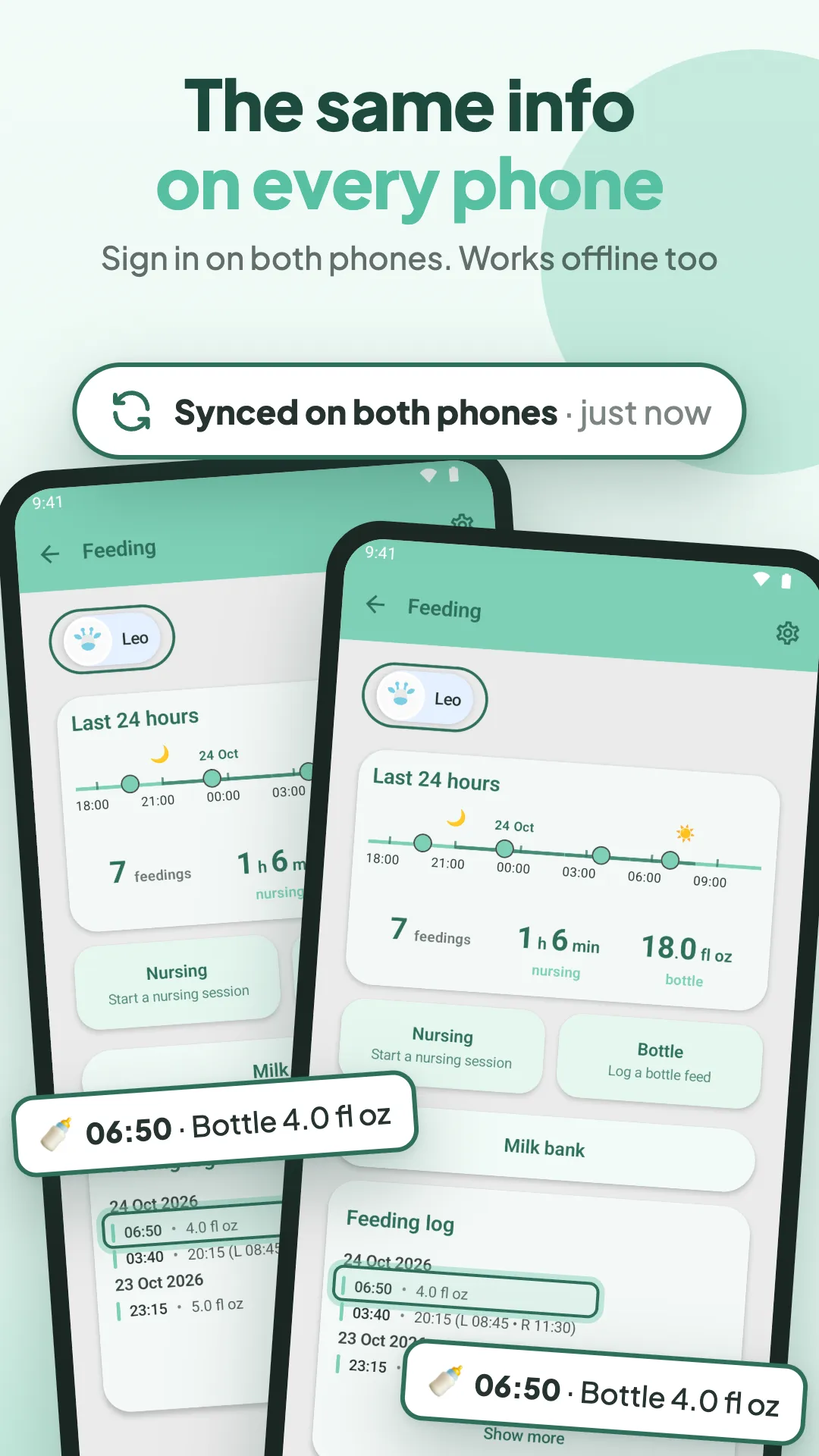
At 2 am nobody remembers when the baby last ate. Sign in to Raffy on both phones with the same Google account (Settings → Account and Sync) and you will both see the same feeds and the same sleeps on your phone. It syncs automatically, though not instantly: give it a few moments if you have just logged something. It is free.
If you do not use an app yet, we compare the options in the best baby tracker apps for Android.
Safety and when to get help
- Never fall asleep with the baby on a sofa or armchair. The risk of sudden infant death is much higher when a baby sleeps with an adult on a sofa or armchair. If you feel your eyes closing during a feed, put the baby in their crib or wake your partner.
- If you drive the next day after a very bad night on duty, let the other drive or wait until you are more rested.
- Ask for help if either of you is sad or hopeless almost every day, enjoys nothing, cannot sleep even when the baby sleeps, or has thoughts of harming yourself or the baby. And it does not only happen to mothers: in studies, around 10% of fathers had depression during pregnancy or the baby's first year, and it is more common around 3-6 months.
- Who to call: your midwife, GP or pediatrician. In the UK, NHS 111 can help if you need medical help now, and Samaritans (116 123, free, any time) listen if you are struggling or have thoughts of harming yourself. In an emergency, call 999.
This article is educational and does not replace an assessment by a health professional.
Frequently asked questions
How do you split the nights with a newborn?
The simplest way is to split the night into two stretches of about 5 hours (for example, 9 pm to 2 am and 2 am to 7 am). Whoever is on duty handles all the wakings in their stretch and the other sleeps without interruption.
Can a partner take shifts if I breastfeed?
Yes. They can handle everything except the feed (changing, burping, settling back to sleep) or, once breastfeeding is well established, give one feed of expressed milk. In that case it helps if the mother expresses a little milk near that time so her breasts do not get uncomfortably full.
Is it better to alternate nights or split each night?
With a newborn it usually works better to split each night, because nobody can manage a whole night of frequent feeds. When the baby wakes less, alternate nights let each of you sleep a full night.
How do we know what happened on the other's shift?
By writing down every feed and every sleep somewhere you can both see, like a shared tracking app. That way the handoff does not depend on what someone half asleep remembers.
What if one of us works outside the home?
The one who works can take the first stretch of the night and sleep straight through the second half, and make up for it with more tasks in the evening and at weekends. What matters is that you decide the split together and review it every few weeks.
Sources
- NHS (UK)Sleep and tiredness after having a baby
- Ready to Relate · Bradford District Care (NHS)Understanding your baby's sleep
- NHS (UK)Expressing and storing breast milk
- NHS (UK)Postnatal depression
- Spanish Association of Pediatrics · Breastfeeding CommitteeBreastfeeding recommendations (in Spanish)
- American Academy of Pediatrics · HealthyChildren.orgA parent's guide to safe sleep
- Health Service Executive (Ireland)Recovering after the birth
- NHS (UK)When to use NHS 111
- SamaritansContact Samaritans: 116 123
- JAMA (2010)Paulson and Bazemore. Prenatal and postpartum depression in fathers and its association with maternal depression: a meta-analysis
- JOGNN (2015)Bhati and Richards. A systematic review of the relationship between postpartum sleep disturbance and postpartum depression
- Family Practice (2025)Yıldırım and Şahin. Does father involvement affect attachment and maternal depression and quality of life? Randomized trial
- Irish Journal of Medical Science (2026)Akça and Tuncay. Fathers' involvement in infant care and infant attachment levels
We checked this article against these sources on Nov 17, 2026. It is educational, not medical advice. Editorial policy